
Understanding the Press Note 3 Regime: From Crisis Response to Policy Recalibration
Press Note 3 (“PN3”) was issued by the Indian Government in 2020 to curb the opportunistic takeover of Indian companies due to the distress/devaluation on account of Covid-19 outbreak. The PN3 amended the FDI Policy[1], restricting foreign investments from the countries sharing land borders with India (“LBCs”)[2] by mandating government approval for any investments in Indian companies by an entity or citizens of an LBC (“Direct LBC Investor”) or where the beneficial owner of the investor was an entity or citizens of an LBC (“LBC BO”). Similar restrictions were also incorporated in relation to the share transfer transaction of Indian entities, resulting in either direct or beneficial ownership falling within the above purview. These changes were also incorporated in the FEMA (Non-Debt Instrument) Rules, 2019 (“NDI Rules”).[3] 7 Land Bordering Countries: China, Pakistan, Bangladesh, Nepal, Myanmar, Bhutan and Afghanistan.
Recently, the Union Cabinet, through a press release[4] (“Cabinet Press Release”), proposed amendments to the FDI Policy to promote foreign inflows in Indian companies and to ease the restrictions faced by global venture capital and private equity funds. Further, some Cabinet Press Release proposals have already been incorporated in the FDI Policy through Press Note 2 (2026) (“PN2”).[5] However, the amendment to the FDI Policy is expected to be operationalised through corresponding amendments to the NDI Rules.
Core Revisions to the Press Note 3 Framework: Decoding the 2026 Amendment
(1) Clarifying the meaning of Beneficial Owner: This is the most important aspect of the PN2 amendment. Earlier, there were varying interpretations as to the thresholds of “Beneficial Owner” with some resorting to the Companies Act, 2013, and some to the Prevention of Money-laundering Act, 2002 (“PMLA”) read with Prevention of Money-laundering (Maintenance of Records) Rules, 2005 (“PML Rules”).
Now, PN2 expressly clarifies that the phrase ‘Beneficial Owner’ shall have the same meaning as defined under S. 2(1)(fa) of the PMLA read with Rule 9(3) of the PML Rules. Further, to determine the applicability of LBC BO, the structure of the investor entity has to be reviewed.
Accordingly, if a Direct LBC Investor, directly or indirectly, or together with any other entity:
(i) holds more than the applicable thresholds over the investor entity as prescribed under Rule 9(3) of the PML Rules (eg. holds 10% (ten percent) or more shares of the investor entity); or
(ii) exercises control over the investor entity (eg. right to appoint majority of the directors or to control the management or policy decisions of the investor entity); or
(iii) exercises ultimate effective control over the investee entity in any manner,
then, the Beneficial Ownership of the investment shall be construed to be vested in a Direct LBC Investor, and such FDI investments shall need prior government approval.
Illustrative transaction structures and regulatory outcomes
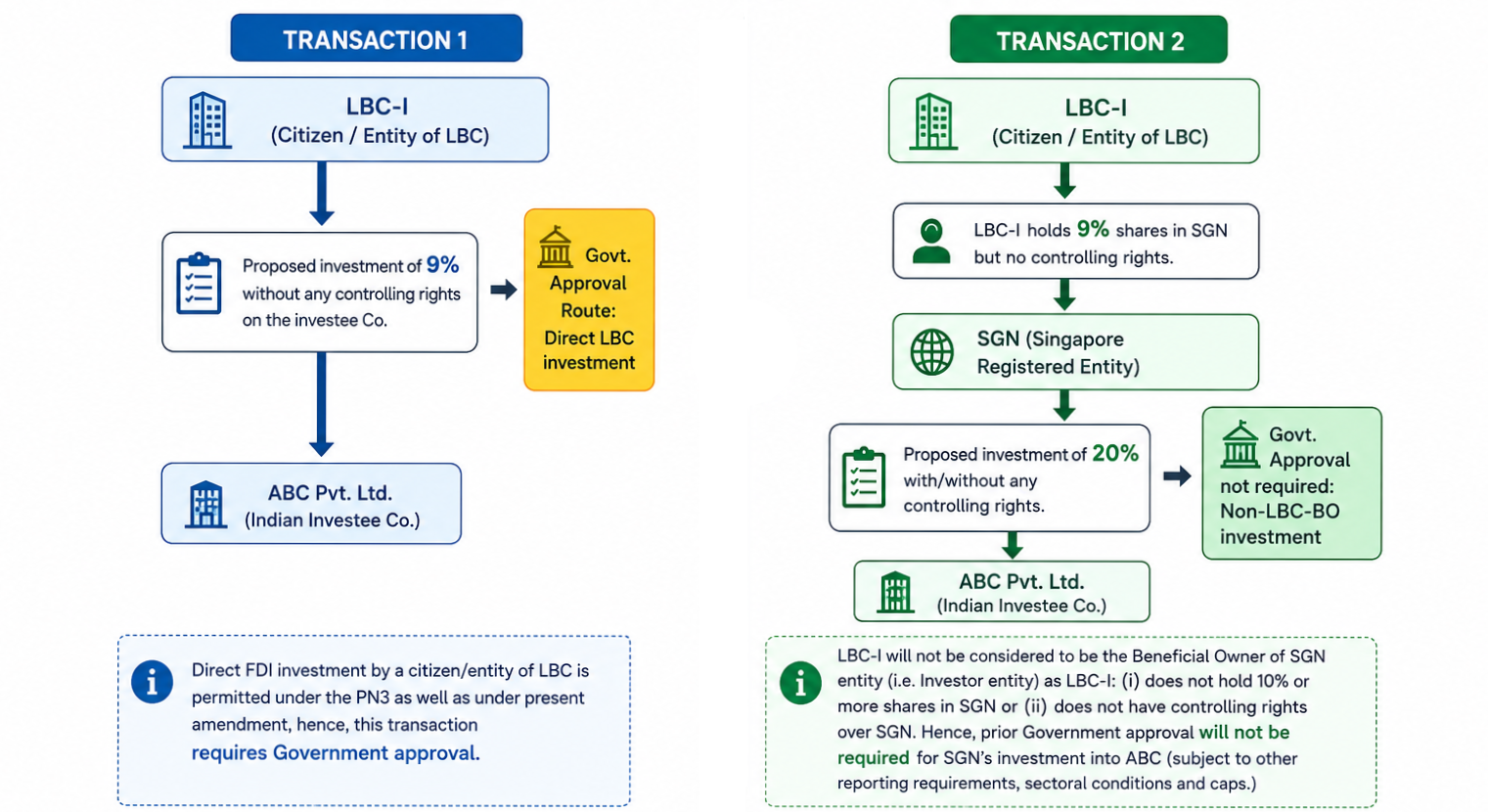
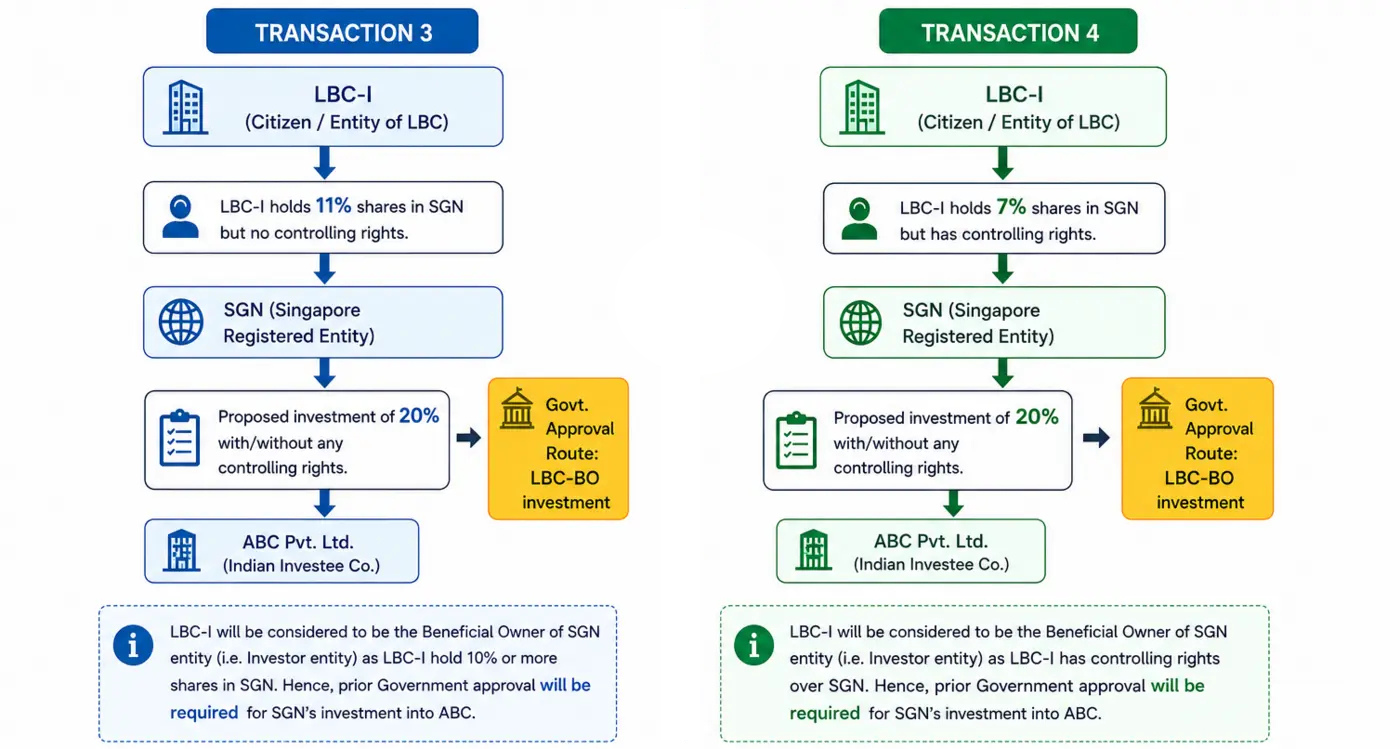
(2) Reporting requirements: If government approval is not required for an investment as per the above criteria, then such investments are required to be reported as per the SOP to be released by DPIIT.[6]
(3) Timeline-Based Approval: The Cabinet Press Release also proposed that for certain specified sectors/activities of manufacturing in capital goods, electronic capital goods, electronic components, polysilicon and ingot-wafer, shall be processed and decided within 60 days. Further, such investments shall be subject to an ongoing condition that the majority shareholding and control of the investee entity will be with resident Indian citizen(s) and/or resident Indian entity(ies) owned and controlled by resident Indian citizen(s).
However, this timeline-based approval has not been incorporated in the FDI Policy amended through PN2. An amendment to the NDI Rules in this regard will provide clarity on whether this intent will be given effect to.
What Has Not Changed: Continuing Restrictions under the Press Note 3
(1) Direct LBC Investment: Any investment by a Direct LBC Investor into an Indian investee entity still needs to follow the government approval route.
(2) Indirect LBC Investment: Any investment where a Direct LBC Investor(s) is the Beneficial Owner of an investor entity situated in a non-land bordering country, will still need to follow the government approval route.
(3) Share Transfer to LBC Investor or LBC BO: Any direct or indirect share transfer of an Indian entity resulting in the Beneficial Ownership moving to, or being acquired by, Direct LBC Investor still requires prior government approval. The only shift is that “beneficial ownership” is now clearly defined (i.e. ≥10% or control), so a transfer will trigger government approval only if it results in such qualifying beneficial ownership or control in favour of a Direct LBC Investor.
(4) Sectoral Cap and Conditions: The sectoral cap and sector-specific conditions remain unchanged, and the investment shall remain subject to such conditions.
Summary Comparison: PN3 (2020) vs Amended Framework (2026)
| Parameter | PN 3 (2020) Position | Amended Position (PN 2 – 2026) | Impact |
|---|---|---|---|
| Basic Restriction | Government approval was required for investments from LBC entities or where BO is from LBC. | Same principle continues. | No change / relaxation. |
| Beneficial Owner (BO) concept | Mentioned but no clarity on definition or threshold. | Explicitly clarified and tied up with PMLA definition (i.e. ≥10% or control). | Clarification provided. |
| Below 10% non-controlling LBC-BO investment | Grey area – was often treated as triggering government approval. | Allowed without Government approval (via Para 3.1.1(d), subject to reporting). | Major relaxation. |
| Transfer of ownership to LBC/LBC-BO | Government approval was required. | Government approval is required. However, the trigger is now tied to defined BO/control. | No change in concept, but clarification is provided on the threshold. |
| Sectoral caps & conditions | Applicable | Applicable | No change. |
Key Takeaways and Way Forward
The amendment effectively shifts the regime from a blanket approval framework to a threshold and control-based screening mechanism. These changes, once notified through the NDI Rules, will be extremely helpful for Indian investee entities that were trying to raise funds through global PE/VC funds but got impacted by the Beneficial Ownership threshold, especially in cases where there was no actual control by Direct LBC Investor(s). Further, incorporating a timeline-based approach (if implemented) will provide much-needed clarity to the investor as well as the investee and help them in an efficient business restructuring.
- Investments involving <10% LBC-BO participation without control rights may proceed without prior government approval, subject to reporting and other sectoral conditions and caps.
- Care must be taken to ensure no indirect control rights arise through shareholder agreements.
- Aggregation of holdings and layered structures should be evaluated carefully.
- In borderline cases, a conservative approach or regulatory consultation may still be advisable.
For any queries or discussions, you can reach out to our contributors:
Akash Kumar (akash@asqlegal.com)
Asutosh Mahapatra (asutosh@asqlegal.com)
*****
References:
- Government of India, Ministry of Commerce & Industry, Department for Promotion of Industry and Internal Trade (DPIIT), Press Note No. 3 (2020 Series) dated April 17, 2020, available at: https://www.dpiit.gov.in/static/uploads/2025/07/712a4fe0dca469cccf01131647e3fa4e.pdf
- Government of India, Ministry of Commerce & Industry, DPIIT, Consolidated FDI Policy Circular of 2020, dated October 15, 2020, available at: https://www.dpiit.gov.in/static/uploads/2025/06/4a159bc3ae98ca3f4a0e495ea2750323.pdf
- 7 Land Bordering Countries: China, Pakistan, Bangladesh, Nepal, Myanmar, Bhutan and Afghanistan.
- Union Cabinet, Government of India, Cabinet approves changes in guidelines on investments from countries sharing land border with India, dated March 10, 2026, available at: https://www.pib.gov.in/PressReleaseDetail.aspx?PRID=2237806®=3&lang=1
- Government of India, Ministry of Commerce & Industry, DPIIT, Press Note No. 2 (2026 Series), DPIIT F. No. 5(5)/2020-FDI Policy (Pt-1), dated March 15, 2026, available at: https://www.dpiit.gov.in/static/uploads/2026/03/b9da5830b052c2f2d788593e97d07c63.pdf
- Id., Para 3.1.1(d), Press Note 2.